Devices


SLODHA Group@IITB

Team Members

Prof. Saurabh Lodha (Lead PI)
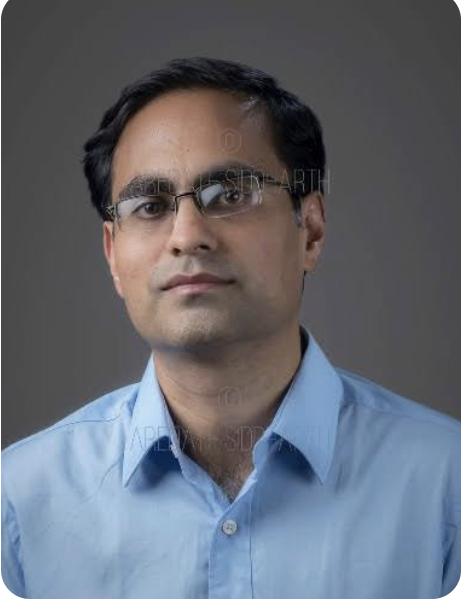
P. K. Kelkar Chair Professor, Electrical Engineering, IIT Bombay
Adjunct Professor, Electrical and Computer Engineering, Ohio State University
Professor-in-charge, IIT-OSU Frontier Research Center
Senior Member, IEEE
Fellow, INAE


Subham Mahanti
Senior Research Fellow


Center for Sophisticated Instruments and Facilities (CSIF, erstwhile CRNTS)
Indian Institute of Technology Bombay

Contact: subhamm@iitb.ac.in 
Linkedin: https://www.linkedin.com/in/subham-mahanti-288294204/ 
Supervisor- Prof. Saurabh Lodha 
Co-supervisor- Prof. Anshuman Kumar

Subham is working on the development of avalanche photodetectors based on two-dimensional (2D) materials, including MoS₂ and WSe₂. His research involves device fabrication, electrical and optoelectrical characterization, and the implementation of single-photon detection schemes to evaluate key performance metrics of these devices. The objective is to assess and benchmark the performance of 2D material-based avalanche photodetectors against commercially available conventional APD technologies.
 

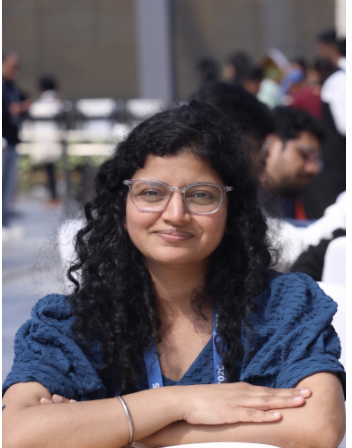
Dr. Mamta Raturi
IPDF
Department of Electrical Engineering
Indian Institute of Technology Bombay

Email: 20003599@iitb.ac.in
Linkedin -https://www.linkedin.com/in/mamta-raturi-aa3218227/
Supervisor- Prof. Saurabh Lodha 


Dr. Mamta specializes in the growth of 2D transition metal dichalcogenide (TMDc) materials, device fabrication, material characterization, and optoelectrical characterization. Her work focuses on advancing 2D material-based device physics while enabling their integration into next-generation industrial technologies. 

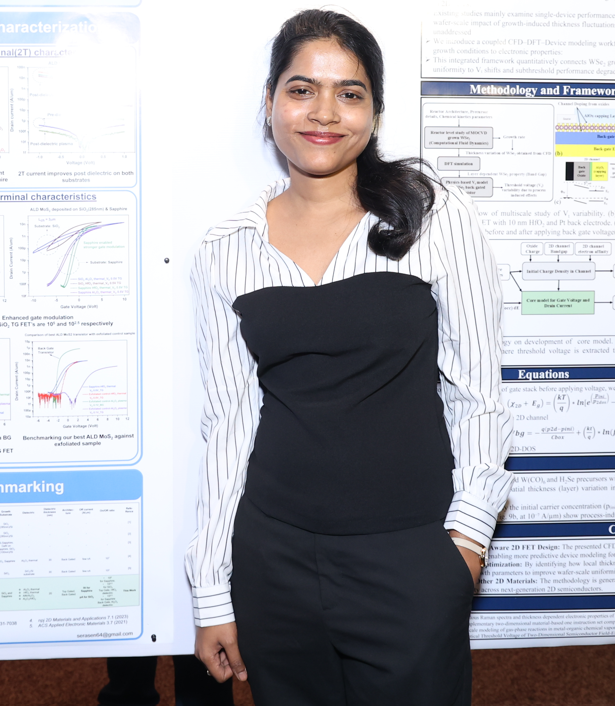
Sera Sen
SRF

Electrical Engineering Department

Indian Institute of Technology Bombay
Contact: serasen64@gmail.com, 23D0555@iitb.ac.in 

Linkedin: https://www.linkedin.com/in/sera-sen-8276351b9/ 

Supervisor: Prof. Saurabh Lodha 

Sera is working on a scalable ALD/CVD-based platform for wafer-scale growth and device integration of 2D TMDC semiconductors for next-generation electronics at IIT Bombay. The work spans material growth, process development, device fabrication, and electrical characterization, targeting BEOL-compatible integration of 2D materials for next-generation logic, memory, sensing, and computing technologies, indigenously.


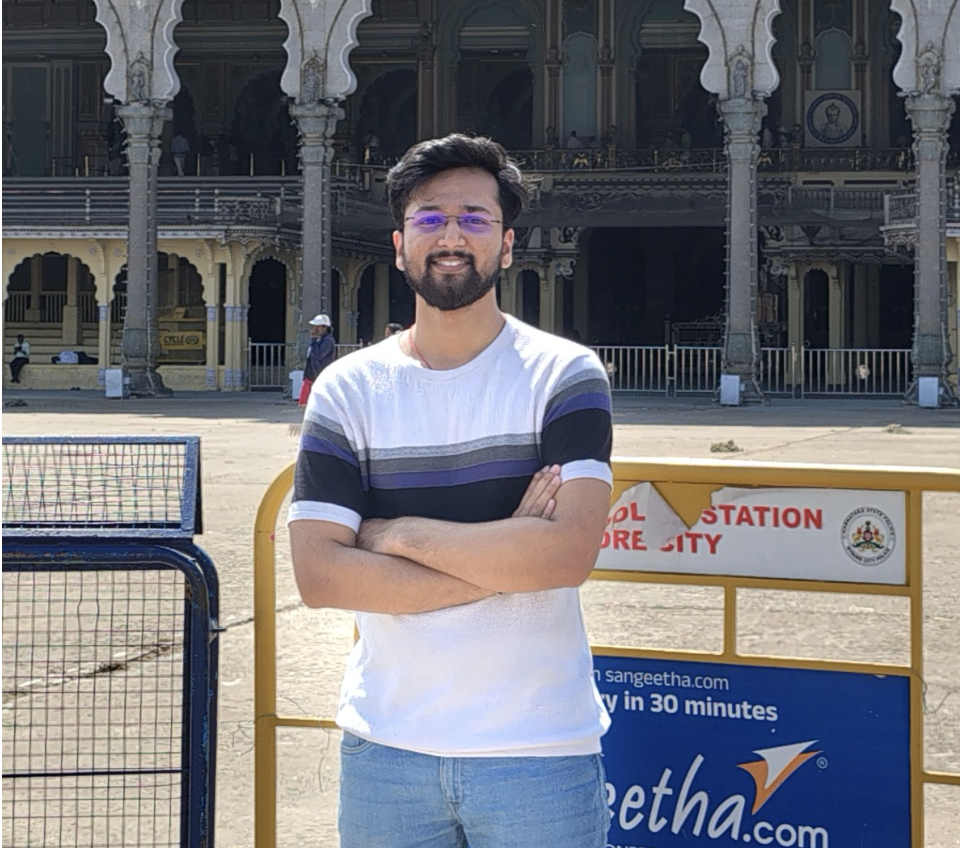
Abhinav Thakur
Project Staff/Associate
Electrical Engineering
Indian Institute of Technology Bombay

Email ID:
LinkedIn: https://www.linkedin.com/in/abhinav-thakur-75035a153/
PI: Prof. Saurabh Lodha

Abhinav is a passionate researcher who is currently interested in exploring the intersection of optoelectronics and quantum hardware. Under the NQM, he focuses on simulating 2D material-based avalanche photodetectors and single-photon avalanche detectors (SPADs).  Before joining IIT Bombay, Abhinav worked as a research intern at National Taiwan University in 2025 to simulate and optimize the performance of III-V APDs. Moreover, in 2024, he also worked towards the modelling of group IV SPAD during a research internship at National Chung Cheng University, Taiwan. He earned his BTech in Electrical and Electronics Engineering and Minor Degree in System-on-Chip Design and IoT from NIT Delhi in 2025. He also has experience with measurement instrumentation and in writing instrument drivers for tools for automated device characterization. He is actively expanding his experimental capabilities through his contributions to characterization, etc. within the group. Abhinav's long-term research and career interests are in qubits and quantum hardware. 


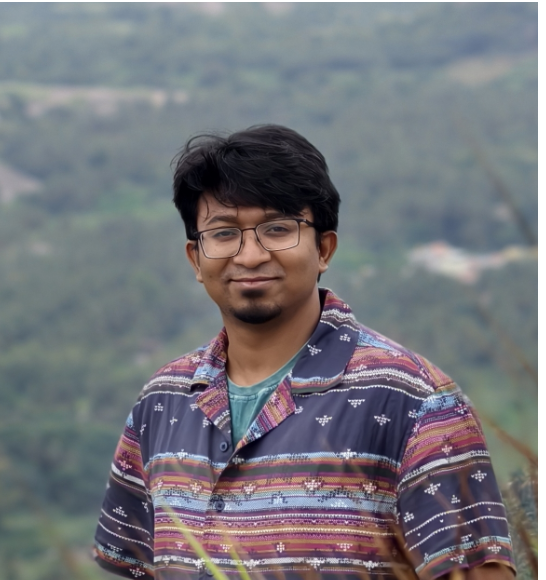
Shantanu Majumder

Project Scientist
Electrical Engineering 

Indian Institute of Technology Bombay

Email id: shantanu93m@gmail.com

LinkedIn : https://www.linkedin.com/in/shantanu-majumder

PI : Prof Saurabh Lodha 

Research Background and interest : Shantanu is an experimental condensed matter physicist, specializing in 2D materials and van der Waals heterostructures In2Se3, MoS2, WTe2, twisted bilayer graphene. His work spans ferroelectric FET, neuromorphic memtransistors, and low-temperature quantum transport. 

​Under the National Quantum Mission, Shantanu actively working towards the development of 2D material-based single-photon avalanche detectors (SPADs). His long-term goal spans device fabrication, and low-temperature/low-noise electrical characterization, integration of 2D materials for next-generation quantum sensing, photonics, and memory devices.
 

LOQM

Laboratory of Optics and Quantum Materials (LOQM), IIT Bombay

The research efforts led by Prof. Anshuman Kumar at the Laboratory of Optics and Quantum Materials (LOQM), Indian Institute of Technology Bombay, focus on the development of quantum photonic devices based on two-dimensional quantum materials and engineered nanophotonic structures. A major research direction is the realization of deterministic, room-temperature single-photon emitters (SPEs) in hexagonal boron nitride (hBN) and their integration with low-loss photonic platforms.

The group investigates the controlled generation and characterization of optically active quantum defects in hBN, together with the development of SiN-based photonic cavities, waveguides, and nanophotonic structures for efficient collection, manipulation, and routing of single photons. Through deterministic emitter engineering, nanophotonic design, and light–matter interaction studies, the group aims to develop scalable integrated quantum light sources for applications in quantum communication, quantum sensing, and integrated quantum information processing.


Group Leader:

Prof. Anshuman Kumar

Associate Professor

Department of Physics

Indian Institute of Technology Bombay

Email: anshuman.kumar@iitb.ac.in

Website: https://loqm.tech


 Group members LOQM, IITB

Dr. Mangababu Akkanaboina

Postdoctoral Fellow

Department of Physics

Indian Institute of Technology Bombay

Email: mangababuind@gmail.com

Supervisor:  Prof. Anshuman Kumar

Linkedin: www.linkedin.com/in/dr-mangababu-akkanaboina-98a17a11a


Mangababu is working on the development and characterization of deterministic hBN single-photon emitters and their integration with SiN nanophotonic structures. His research involves controlled generation and engineering of optically active defects in hBN, along with confocal photoluminescence, TCSPC, and Hanbury Brown–Twiss measurements to establish single-photon emission and characterize emitter properties. His work further focuses on the experimental fabrication and integration of SiN photonic cavities and waveguides with hBN single-photon emitters for enhanced light–matter interaction and efficient coupling of quantum emitters to integrated photonic circuits. The objective is to develop room-temperature, scalable quantum light sources for future integrated quantum communication and information-processing technologies.


Brijesh Kumar

Research Associate

Department of Physics

Indian Institute of Technology Bombay

Email: Brijesh.kumar@iitb.ac.in 

LinkedIn: https://www.linkedin.com/in/brijeshkumar-photonics 

Supervisor- Prof. Anshuman Kumar


Research background and interests:

Brijesh is currently interested in the intersection of nanophotonics and integrated quantum photonic hardware. Under the NQM, he focuses on the design and development of reconfigurable and scalable photonic qubit architectures for quantum computing, using both heterogeneous and monolithic integration approaches, as a Research Associate in the Department of Physics, IIT Bombay. Before this, Brijesh completed his PhD in Physics at IIT Bombay's LOQM-Lab under Prof. Anshuman Kumar, working on bound states in the continuum (BICs) in photonic metasurfaces, with a focus on chirality and sensing applications. In 2025, he worked as a Visiting Research Student at the Australian National University under Prof. Yuri Kivshar, studying chiral nanophotonics and carrying out circular dichroism measurements. He brings over three years of cleanroom nanofabrication and material growth experience from the IIT Bombay Nano-fabrication Facility and TIFR's FOTON lab, and has hands-on experience building a momentum-resolved spectroscopy setup. Brijesh's long-term research and career interests lie in scalable photonic qubit architectures and integrated quantum photonic hardware.


Divyanshu Tiwari

Research Scholar

Department of Physics

Indian Institute of Technology Bombay

Email: divyanshu.tiwari@iitb.ac.in

Linkedin: https://www.linkedin.com/in/divyanshu-tiwari-iitb

Supervisor- Prof. Anshuman Kumar


Divyanshu is engaged in the development of advanced photonic devices, with a specific focus on the simulation, fabrication, and characterization of integrated silicon nitride frequency combs and ring resonators. His research directly aligns with the key focus areas of Photonic Circuits and their integration with wafer scale emitters. A significant portion of his work is dedicated to the design and development of quantum photonic circuits. This encompasses the engineering of reconfigurable and scalable photonic qubit architectures utilizing both heterogeneous and monolithic integration approaches. Furthermore, Divyanshu is involved in the rigorous testing, validation, and development of fundamental building blocks critical for establishing robust quantum photonic networks.